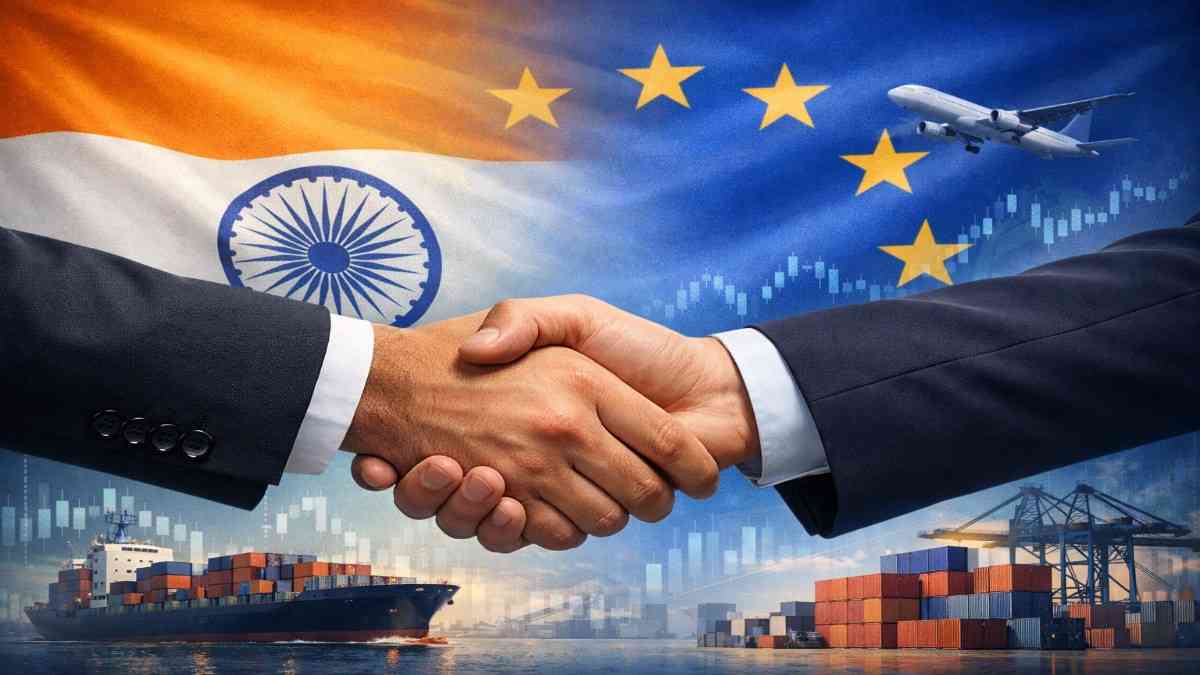
A long-awaited free trade agreement between India and the EU has been finalized. This agreement covers economies that account for one-third of global commerce and almost 25% of the world’s GDP. As the two biggest democracies in the world look to protect themselves from erratic relations with the US, the agreement will deepen their political and economic connections.
Under the historic agreement, the EU would lower tariffs on 99.5% of commodities exchanged over seven years. Tariffs on Indian marine goods, leather and textile products, chemicals, rubber, base metals, and jewelry and gems will be eliminated. By lowering tariffs on 96.6% of traded items by value, the agreement is estimated to treble EU exports to India by 2032, saving European businesses up to 4 billion euros ($4.75 billion) in charges, according to the EU.
One of the main negotiators, Commerce and Industry Minister Piyush Goyal, stated that India will receive “unprecedented” market access at concessional duties for more than 99 percent of its exports by value in the European Union (EU) market, opening up enormous opportunities for 1.4 billion people in the USD 20 trillion EU market.
Additionally, the agreement is anticipated to help MSMEs, women, youth, craftsmen, workers, students, skilled professionals, fishermen, farmers, and exporters in addition to creating enormous trade and investment prospects for Indian firms.
With New Delhi planning to reduce taxes on European automobiles from as high as 110% to 10% over five years, European automakers like Volkswagen, Renault, Mercedes-Benz, and BMW are anticipated to become more affordable.
Additionally, India has agreed to immediately reduce its tariffs on alcoholic beverages, such as wines, from 150% to 75%, with a gradual reduction to 20%. The EU announced that spirits tariffs would be reduced to 40%.
Days after India concluded agreements with Britain, New Zealand, and Oman, the EU and India signed an FTA. The US-India trade agreement fell last year due to a communication failure between the two countries. Talks between India and the EU were resumed in 2022 following a nine-year hiatus, and they gained impetus after Trump imposed tariffs on several trading partners.